
Last quarter, a client’s bookkeeper coded every Uber Eats receipt as a fully claimable business expense. Forty-seven transactions. Full GST recovery claimed on all of them. When we pulled the file for review, not one receipt had a documented business purpose, and half were personal meals. The ITC claim on that return dropped by over $1,800 once we cleaned it up. That’s money the CRA would have come looking for eventually, and the client would have owed it back with interest.
An Input Tax Credit is the mechanism that lets GST/HST registrants recover the tax they paid on purchases used in commercial activities. You claim it on line 106 of your GST/HST return, and it reduces your net tax owing. Simple concept. The hard part is proving every dollar.
By the end of this article, you’ll understand exactly how ITCs work in Canada, what makes a claim defensible, where most businesses lose money they’re entitled to, and how to build a bookkeeping workflow that protects your claims before you file.
Who this applies to (and who should skip ahead)
If you’re a GST/HST registrant making purchases for commercial activities, this is your territory. CPAs preparing client returns, bookkeepers managing transaction categorization, controllers reconciling multi-entity books, small business owners filing their own GST34. All of you.
If you’re an unregistered small supplier under the CRA’s revenue threshold, you can’t claim ITCs. Stop here and read our GST/HST registration guide for Canadian businesses instead. Same goes if you’re only making exempt supplies. Your situation needs a different conversation, one about zero-rated vs exempt supply classification.
The mechanism behind Input Tax Credits
Most guides define ITCs and move on. That misses the point.
An ITC isn’t a refund. It’s a credit against the GST/HST you collected from customers. The CRA designed the system so that tax cascading doesn’t happen. Each business in the supply chain recovers the tax it paid on inputs, and only the final consumer bears the full tax burden. That’s why the system exists.
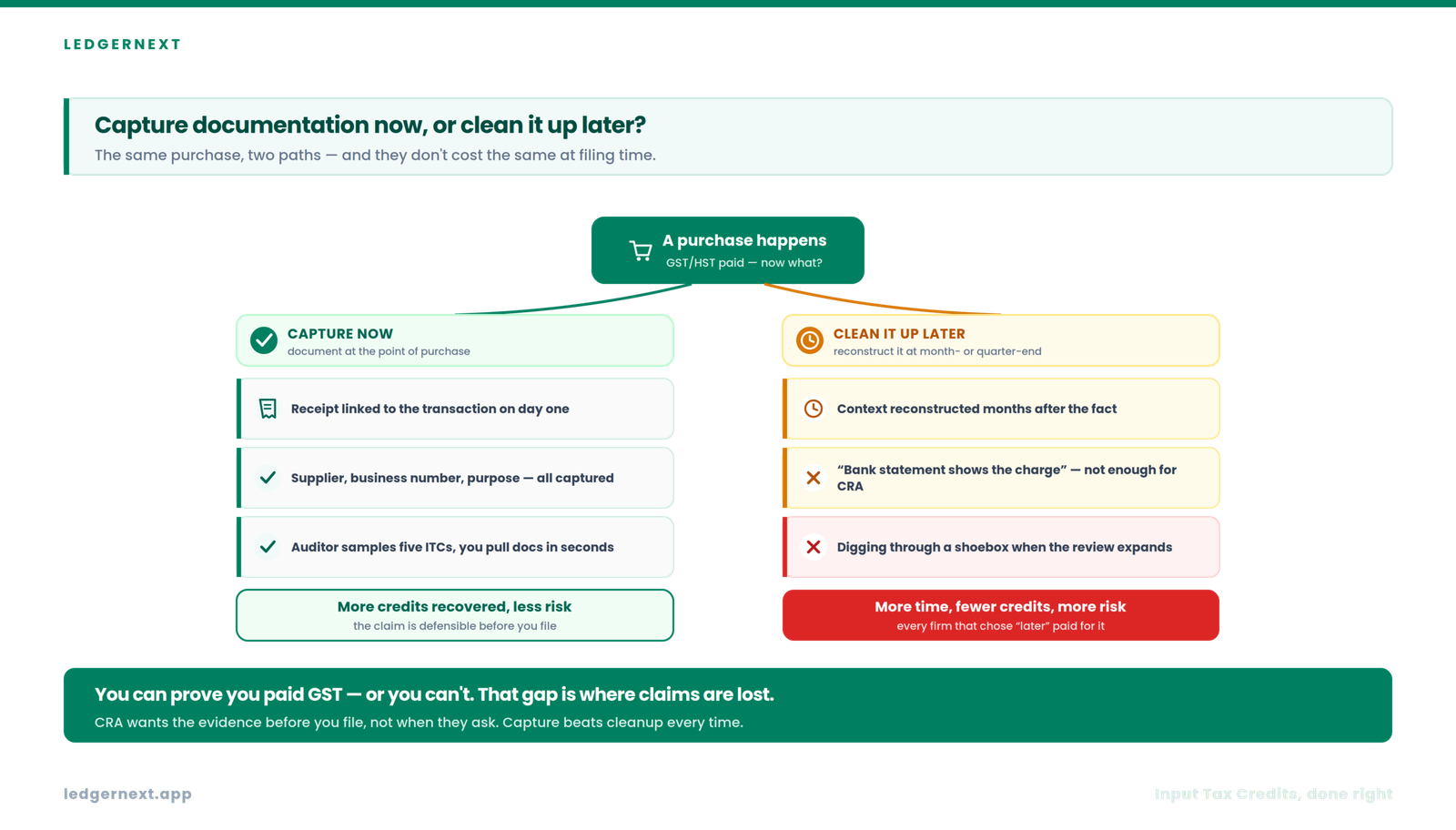
The constraint that makes this complicated: CRA requires you to have sufficient documentary evidence before you make the claim. Not after. Not when they ask. Before you file. The Input Tax Credit Information Regulations set out exactly what that documentation must contain, and “I have a bank statement showing the charge” doesn’t cut it.
Here’s where published guidance and practice diverge sharply. CRA’s documentation rules seem straightforward on paper. In a live bookkeeping environment with 300 transactions a month across multiple expense categories, the gap between “we paid GST on this” and “we can prove we paid GST on this, to a specific supplier, with their business number, for a commercial purpose” is where firms lose legitimate claims constantly.
The decision this creates: do you invest in capturing documentation at the point of purchase, or do you clean it up later? Every firm I’ve worked with that chose “later” spent more time, recovered fewer credits, and carried more risk into filing.
Who can claim and what qualifies
Only GST/HST registrants can claim ITCs, and only for purchases consumed or used in commercial activities. CRA is specific about this. The purchase has to be for your business, the GST/HST has to have been paid or payable, and you need documentation that satisfies the prescribed information requirements.
Eligible vs non-eligible expenses
| Category | Eligible for ITC | Notes |
|---|---|---|
| Office supplies, software subscriptions | Yes | Full ITC if 100% business use |
| Commercial rent (from GST-registered landlord) | Yes | Verify landlord’s registration |
| Professional services (legal, accounting) | Yes | Confirm GST/HST shown on invoice |
| Vehicle expenses (business use) | Partial | Proportionate allocation required |
| Meals and entertainment | Partial | ITC limited; follows income tax limitation rules |
| Employee personal benefits | No | Not for commercial activities |
| Residential rent | No | Exempt supply |
| Life/health insurance premiums | No | Financial services, exempt |
| Personal expenses coded to business | No | Ineligible regardless of GST charged |
One thing that trips up newer bookkeepers: a receipt showing GST doesn’t automatically mean the ITC is claimable. The expense still has to connect to commercial activity. I’ve reviewed files where a client’s gym membership was coded with HST and claimed. Technically, yes, HST was charged. But the CRA isn’t going to accept your spin class as a commercial input.
What CRA actually requires for documentation
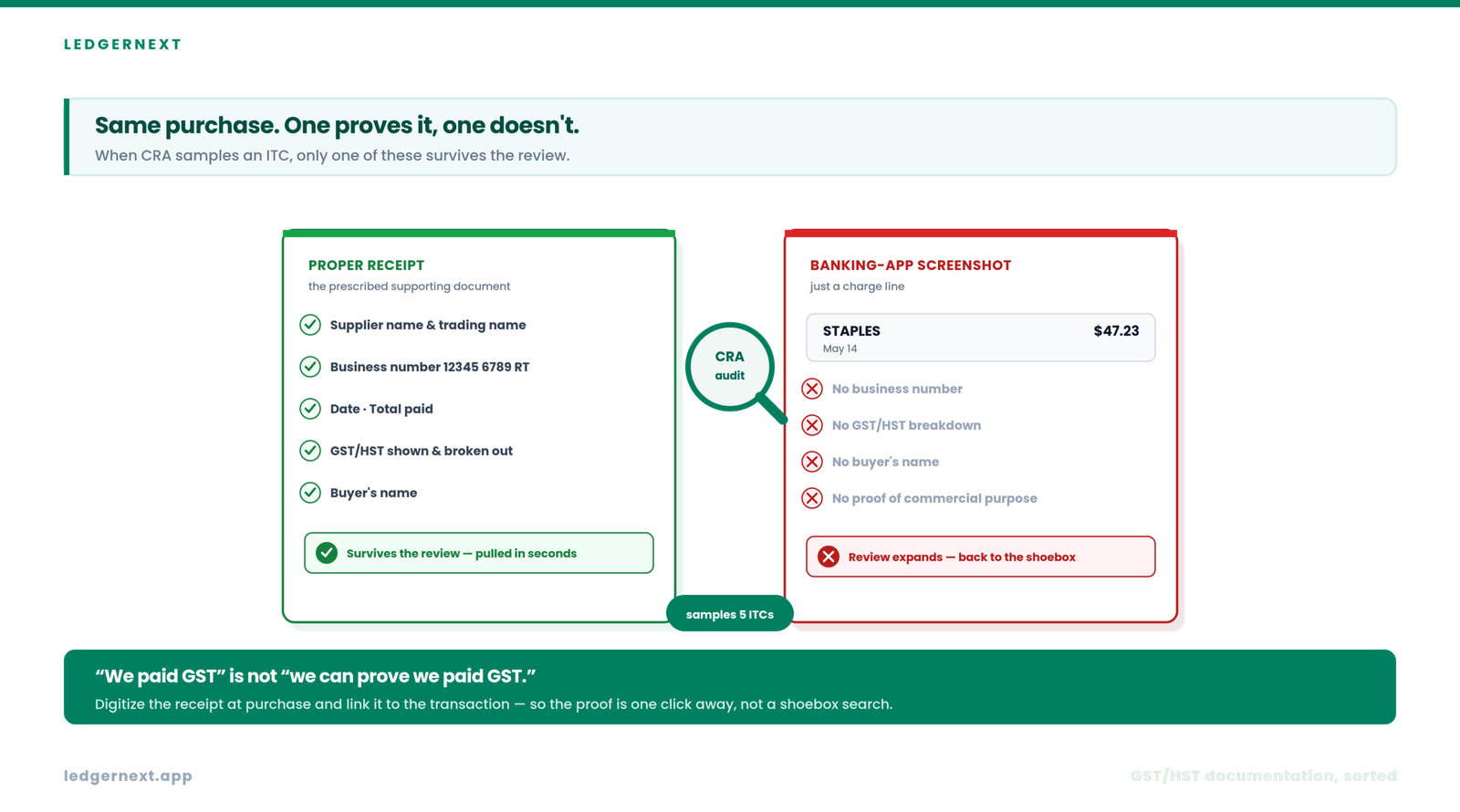
CRA’s documentary requirements scale with the transaction amount, but even for purchases under $30, certain information has to be present. The supplier’s name or trading name. The date. The total paid. An indication that GST/HST was charged. For anything over $150, you also need the supplier’s business number, the buyer’s name, and the tax broken out separately.
CRA accepts invoices, receipts, credit card slips, debit notes, written contracts, and computerized or electronic records. The key word is “acceptable.” A screenshot of your banking app showing “STAPLES $47.23” isn’t prescribed supporting information.
Firms that digitize receipts at the point of purchase and link them directly to the transaction in their general ledger cut their CRA review response time dramatically. When an auditor samples five ITCs from your return and you can pull the supporting document in seconds, the review moves fast. When you’re digging through a shoebox or searching old email threads, that’s when reviews expand in scope.
Common ITC mistakes that cost real money
The pattern I see most often across client files isn’t dramatic fraud. It’s quiet erosion. Small, repeated failures that compound over multiple filing periods.
Inconsistent GST/HST coding is the biggest offender. The same vendor gets coded with tax in January and without tax in March. Nobody catches it because nobody runs an exception report before filing. Over a year, that inconsistency can mean thousands in unclaimed or over-claimed credits.
Missing tax codes on recurring expenses is the second. A monthly software subscription at $200 plus GST runs for twelve months. If the bookkeeper misses the tax code on six of those entries, that’s six months of ITCs sitting on the table.
Mixed-use expenses without proportionate allocation create a different risk. A vehicle used 60% for business should only generate ITCs on 60% of the GST paid. Claiming 100% is an audit trigger. Claiming 0% because the allocation felt too complicated is leaving money behind.
And then there’s the deadline issue. CRA states ITCs must be claimed within the applicable time limit, which practitioner sources commonly cite as four years from the due date of the return in which the credit first became available. Miss that window, and the credit is gone.
The CLAIM Framework
I use a five-step workflow for ITC management that keeps claims clean and defensible. I call it CLAIM.
Before anything else, verify the entity is a GST/HST registrant and the expenses relate to commercial activities. This sounds obvious until you’re managing fifteen client files and one of them lost their registration status six months ago.
Not at month-end. Not at quarter-end. Weekly bookkeeping produces more accurate ITC claims than quarterly cleanup because errors compound when you batch.
The invoice, the receipt, the contract. Linked, not floating in a shared drive somewhere.
Is it taxed at 5%? 13%? 15%? Is it exempt? Zero-rated? Is there a partial restriction? Getting this wrong cascades through the general ledger, the trial balance, and ultimately the GST34.
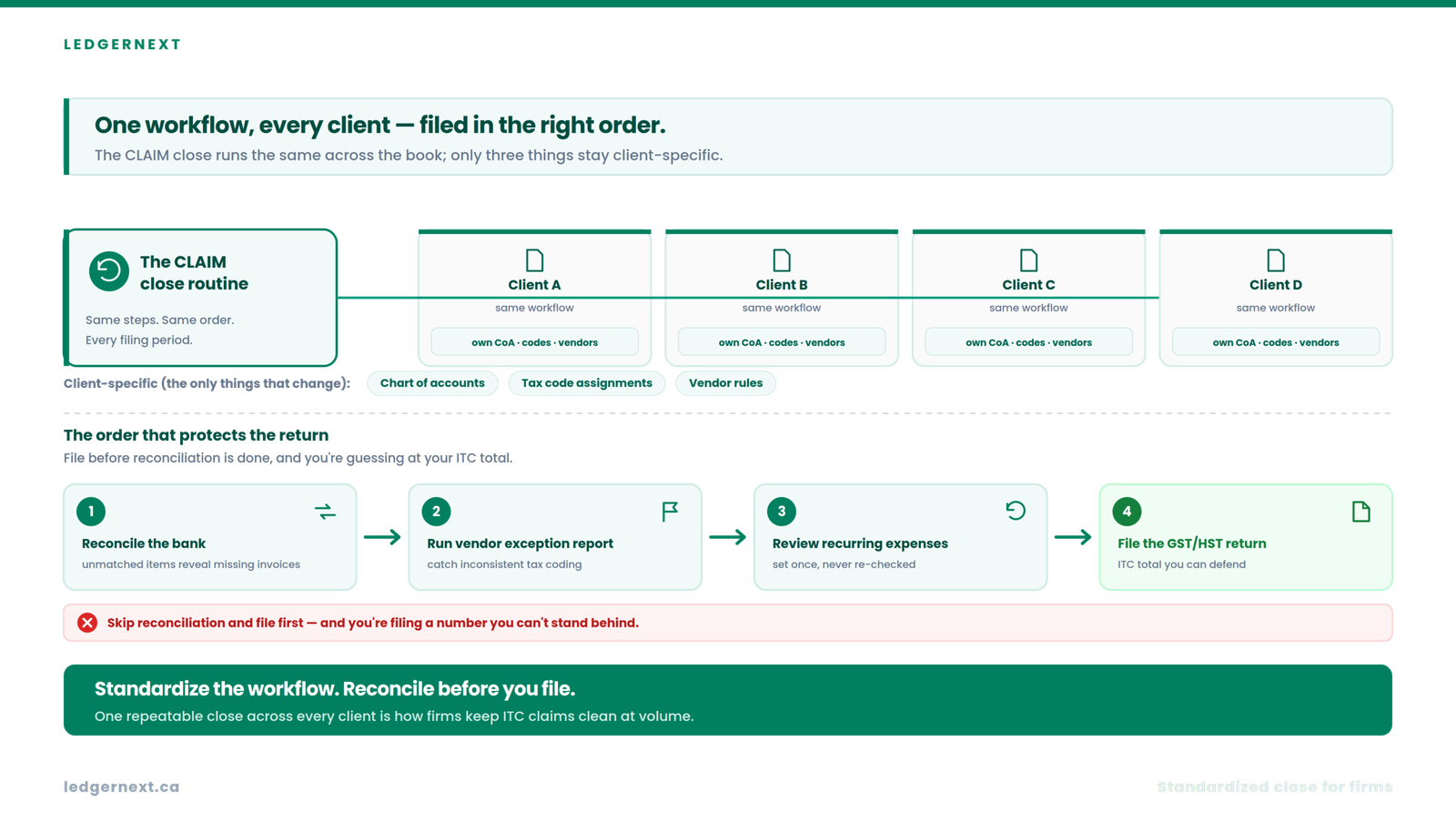
Run your bank reconciliation first. Then review your tax code reports. Then check for missing tax codes. Then reconcile your ITC total to your supporting documents. Then file.
Skip any step, and you’re either leaving credits on the table or claiming credits you can’t defend.
Catch coding errors before they cost you credits
Inconsistent tax codes, missing documentation, and unreviewed recurring expenses are exactly what LedgerNext’s tax code reports and missing tax code reports surface—before you file, not after the CRA asks.
How accounting firms standardize this across clients
For firms managing multiple client books, the CLAIM Framework scales when you build it into your month-end close checklist. The workflow looks the same for every client, but the chart of accounts, tax code assignments, and vendor rules are client-specific.
The firms I’ve seen do this well run a vendor-level exception report before every filing period. They sort by vendor, check for inconsistent tax coding, and flag anything that changed without explanation. They review recurring expenses specifically, because those are the transactions most likely to be set up once and never checked again.
Bank reconciliation should always precede GST/HST filing. Unmatched transactions often reveal missing invoices or incorrect coding that would affect the return. If you’re filing before reconciliation is complete, you’re guessing at your ITC total. For more on why this step takes so long and how to fix it, see how Canadian accounting firms can speed up bank reconciliation.
Where practitioners disagree
There’s an active debate among practitioners about whether ITCs should be reviewed at the transaction level or the account level during pre-filing review. Some CPAs insist on sampling individual transactions against source documents for every filing period. Others argue that account-level analytics (comparing ITC ratios period over period and flagging anomalies) catch more errors faster, especially at volume.
I lean toward the account-level approach as the primary screen, with transaction-level sampling for flagged accounts. Pure transaction sampling at scale is a time sink that doesn’t always surface systemic coding errors.
The problems nobody talks about
| Problem | The fix that actually works |
|---|---|
| ITCs are lower than expected but the return “ties” | Split personal and business expenses by vendor pattern; reclassify the top 20 recurring transactions first |
| Client says receipts are “in the cloud somewhere” | Force one intake channel and enforce a monthly close cutoff |
| Same vendor coded differently across months | Run a vendor-level exception report before filing |
| Meal receipt claimed at 100% | Apply partial ITC logic and document the business purpose on the entry |
| CRA samples five receipts and two are incomplete | Build a receipt checklist capturing supplier name, date, amount, GST/HST, and registration number |
| Old-period ITCs discovered during year-end | Use a period-by-period aging schedule; flag claimable but unfiled items before the deadline passes |
How technology fits in
The pain points above are workflow problems. Messy categorization, missing tax codes, disconnected documents, inconsistent coding across clients.
Organized ITC workflows start with organized books
If your firm manages multiple client files and struggles with inconsistent GST/HST coding, missing documentation, or pre-filing review bottlenecks, LedgerNext supports ITC tracking, GST/HST summaries mapped to the GST34, tax code reports, missing tax code reports, and multi-client bookkeeping from a single platform.
Frequently asked questions
Can ITCs be claimed on every purchase?
No. Only purchases made by a GST/HST registrant, used in commercial activities, where GST/HST was actually paid or payable, and supported by prescribed documentation qualify for Input Tax Credits. Personal expenses, exempt supplies, and purchases without adequate records are not claimable, regardless of whether tax appeared on the receipt.
What happens during a CRA review of ITCs?
CRA typically samples a selection of claimed credits and requests the supporting documentation. If your records satisfy the Input Tax Credit Information Regulations, the review closes quickly. Incomplete records can cause the review to expand.
How do ITCs affect my GST/HST return?
Your ITCs go on line 106 and directly reduce your net tax. If your ITCs exceed the GST/HST you collected, you receive a refund. This is why accurate transaction categorization and correct tax coding matter so much. Errors in either direction affect your cash flow and your compliance position.
Is weekly bookkeeping really necessary for accurate ITCs?
It isn’t mandatory. But quarterly cleanup means you’re reconstructing context months after the fact. Which receipt was business? What was that $340 charge? Weekly entry keeps the answers fresh, the coding consistent, and the documentation attached while you still remember what happened.
How long do I have to claim an ITC I missed?
Practitioner sources commonly reference a four-year window from the due date of the return in which the ITC first became claimable. After that, the credit expires. A period-by-period aging schedule helps you catch these before they’re lost.
ITC compliance checklist
The next problem most firms hit after getting their ITC workflow right is figuring out how their financial reporting connects to advisory conversations with clients. That’s a different article, but the foundation is the same: clean books, consistent coding, defensible records.
Make every ITC claim defensible before you file
LedgerNext brings ITC tracking, GST/HST summaries mapped to the GST34, tax code and missing-tax-code reports, and multi-client bookkeeping into one platform—so consistent coding and clean documentation become the default across every client file.